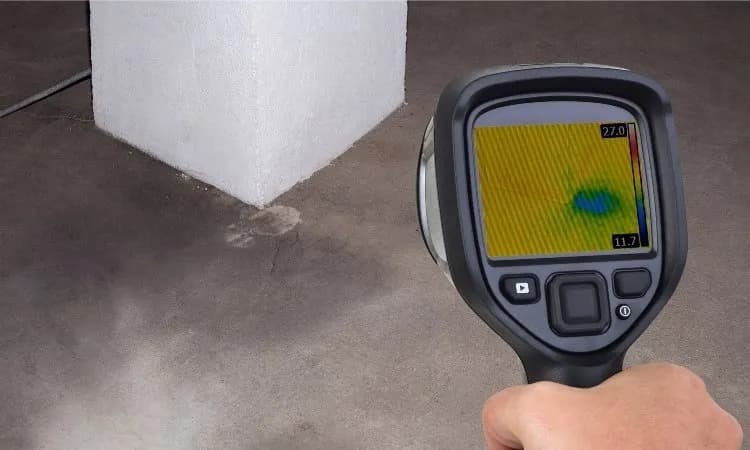
Signs You May Have a Hidden Leak
Not every leak drips visibly. Water can escape inside walls, under floor tiles or above ceilings for weeks before you notice. Watch for these warning signs:
- A water bill that rises without any change in how you use water
- Damp patches, peeling paint or ceiling stains
- Hollow-sounding or lifting floor tiles
- A musty smell in a closed room
- The sound of running water when everything is switched off
The 5-Minute Water Meter Test
This is the quickest way to confirm whether water is being lost somewhere in your home.
- Make sure nobody is using water. Close all taps and switch off the washing machine, dishwasher and any water filter.
- Find your water meter. Its location depends on your building type, so ask your management office if you are unsure.
- Note the reading, or look at the small flow indicator or dial on the meter face.
- Wait 15 to 30 minutes without using any water.
- Check again. If the reading has changed, or the indicator is still moving, water is leaking somewhere.
Tip: Take a photo of the meter before and after the test. It gives you a clear record to show your plumber or building management.
Rule Out the Easy Culprits First
Many apparent leaks turn out to be a fixture that is quietly wasting water. Check these before assuming the worst.
| Suspect | Quick Check | What It Means |
|---|---|---|
| Toilet cistern | Add a few drops of food colouring to the cistern and wait 15 minutes without flushing | Colour in the bowl means water is leaking past the flush valve |
| Taps and mixers | Look for drips at the spout and under the basin | A worn washer or cartridge needs replacing |
| Washing machine hoses | Check the tap and hose joints for moisture | A loose or ageing connection is leaking |
| Water heater connections | Look for damp around inlet and outlet pipes | A fitting or valve may be failing |
If the Meter Still Moves: It Is Probably in the Pipes
When fixtures check out fine but the meter keeps moving, the leak is likely in a concealed supply pipe. Please resist the urge to start breaking tiles. Random hacking is expensive and often misses the source.
A professional uses pressure testing to confirm whether a line is losing pressure, then isolates sections of the system to narrow down the location. That means a small, targeted repair instead of a large renovation.
Why You Should Not Wait
- Hidden moisture can lead to mould and damaged finishes
- A leak can affect the neighbour below and create disputes
- You keep paying for water you never use
- Small pipe defects tend to get worse over time
If you have done the meter test and it shows a leak, our team can pinpoint the source and repair it with minimal disruption.
Where Hidden Leaks Usually Start
Knowing the usual trouble spots makes the search much easier. In most homes, concealed leaks begin in a handful of places.
Joints and Fittings
Pipes themselves are fairly tough. The weak points are the joints, elbows and connectors where two pieces meet. Over the years, movement, temperature changes and ageing seals can loosen these connections, and a slow weep develops. Because most joints sit inside walls or under floors, you will not see them until the damage shows on the surface.
Pipes Around Wet Areas
Bathrooms and kitchens have the most pipework packed into the smallest space. Supply lines to the basin, shower, heater and sink all run through the same walls. A tiny fault here can soak a wall for a long time before the paint bubbles or a stain appears on the other side.
Heater and Appliance Connections
Water heater inlets, washing machine taps and dishwasher connections are under constant pressure. Rubber seals dry out, and flexible hoses weaken. These leaks are often small but steady, which is exactly the kind that quietly lifts your bill.
Old or Poorly Installed Pipework
If your home has had earlier renovation work that was rushed or never pressure tested, a faulty joint may have been buried from day one. These leaks can take months to show.
How to Read Your Water Bill Like a Detective
Your bill is more useful than most people realise. Instead of looking only at the total, compare it with previous months and ask a few simple questions.
- Has the number of people at home changed, for example guests staying or a new family member?
- Did you add a new appliance, a water filter or a heater recently?
- Were you away for a while? A bill that stays high while you are travelling is a strong clue.
- Did the rise happen suddenly in one month, or build up slowly over several?
A sudden jump with no change in habits points to a new fault. A slow creep upward can suggest a small leak that keeps getting bigger, or a fixture that is gradually wearing out. Either pattern is worth investigating with the meter test above.
What Professional Leak Detection Actually Involves
Many homeowners imagine a plumber simply taps the wall and knows where the leak is. In reality, good detection is a step-by-step process of narrowing down the problem.
- Listening to the history. When did you first notice the sign? Has any renovation been done? Which areas feel damp?
- Visual inspection. The plumber checks fixtures, connections, ceilings, walls and floors for stains, swelling or mould.
- Meter confirmation. The meter is checked with everything off to confirm that water is really being lost.
- Isolating sections. Valves are closed one section at a time. When the meter stops moving, the leak is in the section just isolated.
- Pressure testing. The suspect line is tested to see whether it holds pressure.
- Pinpointing the spot. Depending on the case, tools such as moisture meters or listening equipment can help narrow down the location before any opening up is done.
- Repair and retest. After the fix, the line is tested again to confirm the system is sound.
Understanding Pressure Testing
A pressure test is a simple idea. A section of pipe is closed off, filled with water or air to a set test pressure and watched for a period of time. A healthy pipe holds the pressure steady. If the pressure drops, there is a leak somewhere in that section.
This is also the method used on new pipework during renovation. Testing before the walls are closed and the tiles are laid lets any faulty joint be fixed cheaply, while everything is still open.
| Situation | Why a Pressure Test Helps |
|---|---|
| New pipes installed during renovation | Confirms joints are tight before they are covered |
| Meter moves but no visible leak | Shows whether a supply line is losing water |
| Damp wall or ceiling stain | Helps tell a supply pipe leak from other moisture sources |
| After a pipe repair | Proves the repair is holding |
Not Every Damp Patch Is a Supply Pipe Leak
It is easy to assume that any damp wall means a burst water pipe, but moisture has several possible sources. Knowing the difference saves time and money.
- Waste or drain pipe leaks: these usually appear when water is used and may come with odour.
- Failed waterproofing: bathroom floors can seep into the ceiling below even when the pipes are fine.
- Condensation: cold pipes and poorly ventilated rooms can create moisture without any leak.
- External seepage: rain entering through windows, façades or neighbouring units.
This is why a proper test matters. If the meter does not move and the supply lines hold pressure, the source is probably elsewhere, and you can look at drainage or waterproofing instead of paying for the wrong repair.
If a leak affects the unit below or beside you, inform your management early. Clear communication and documented test results make it far easier to work out where the problem comes from and who needs to fix it.
How to Prevent Hidden Leaks in Future
- Check your water meter every few months and note the reading when nothing is running.
- Replace worn flexible hoses and tap washers before they fail.
- Fix dripping taps and running toilets promptly.
- Have new renovation pipework pressure tested before it is covered.
- Keep isolating valves accessible and make sure they turn freely.
- Act quickly on small signs such as stains, smells or a rising bill.
The Bottom Line
A hidden leak rarely announces itself loudly. The meter test, a careful look at your bill and a few simple fixture checks will tell you quickly whether you have a problem. When the signs point to a concealed pipe, accurate testing and targeted repair is the cheapest, cleanest route. If you are unsure, it is far better to have it checked than to keep paying for water you never use.
Need a Plumber in Singapore?
Talk to the team at SG Plumbing Service Pte Ltd for a clear quote before any work starts.
- Phone: +65 8434 3660
- WhatsApp: +65 8544 8704
- Email: sgplumbingservice@gmail.com
- Address: 234 Serangoon Road, #04-234E, Singapore 218083
- Website: www.sgplumbingservice.com